Back to the discussion
about the concept creative city. I started to think about different cities in
the world. I have travelled quite on lot during my short life. And I have seen
many cities. Nice ones, neutral ones and not so nice ones. But none of the
cities have I hated. Why? Well, it is
maybe not so clear or self-evident but all the cities have had something
interesting or nice in them. Not all of them have been pretty or full with activities
or nice people. But they have deserved different meanings. I would not go to
Playa del Ingles if I would want experience a historic city with an old
culture. But it does not mean that the city could not be creative. It just has
a different function. Actually, it would be almost uncreative if all cities in the world would be similar and equally
creative. As the authors Luckman, Gibson and Lua point out in one of their
articles about the city Darwin and its creativity, one must be realistic – what
resources does a city have to be as creative as possible? So, if one does not
have a lot of great industry, landscapes or fashionistas, the only solution is
to come up with the best with own resources, in a creative way.
This makes sense. I
start to understand the concept. It is not the material assets that count but
rather the intellectual ones. I would at least like to live in a city which is
original. Locally made is always better than ready imported solutions. Think if
there would be a creative city factory. The once defined and invented concept
of a creative city would be sold and produced all over the world. The mayor of
a city could call and order one creative city. Fast delivery and guaranteed
success, or? How creative would that actually be? A sort of creative city
suicide, I would say.
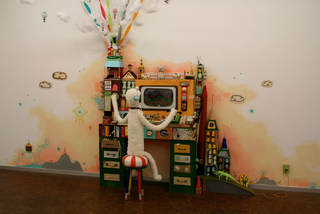
Creative city machine
Picture from ArtSlant LA
And the article I mentionned can be found from here
Back to business again after a relaxing weekend in Hamburg which was such a nice city. Or maybe nice is a too lame expression, creative could be more suitable.
Creative or just a mess?
Previously in my blog I though that creative city would be a stupid expression. Actually, I still think it is, but at least it got a new meaning today at Alf Rehn's lecture.It is maybe not so easy to understand as creativity on personal or organizational level since a creative city always is a mixture of different cultures and interests.An expert in his field, author Charles Landry for example stated in one of his books (2008) that characteristics for a creative city include risk taking, widespread leadership, a sense of going somewhere and being strategically principled and tactically flexible. Should we believe him? For example being a creative city does not mean that the city would have to come up with something new. Much of creativity deals with finding a balance between new and old ways of working and with determining when a change is needed. The most creative solutions are often combination of the old and new. I find this quite interesting and I must say that I agree with him. In Hamburg for example, there was one really good example of this: bike renting. It was done extremely easy and you could reach the whole city with your bike. Bike renting as such is of course not so creative but it can be seen as an example of a creative solution for decreasing the amount of traffic pollution in the city. The renting, or actually the loaning process was made as easy as possible with the help of the latest technology even if the idea itself was not so new. I felt so happy when riding my bike in the sunshine. Creativity almost poured out of me. Yep, yep.
The Hamburg's understanding of creativity (photo from Hamburg.de)
Creativity depends much on the surrounding circumstance and the context which of course in natural. The above mentioned bike hiring would probably not be so creative in Alaska, where the roads are slippery almost the year round.
Much of this creativity talk is still for me too self-evident and does not bring so much new to the table. Maybe not many of you would be surprised if I (or any author or lecturer) would say that open-mindedness and capacity to listen would be the most important conditions for creativity. You don't have to be an expert to realize that. But this is as well a bit contradictory. For example the school system is criticized to be too systematical and pragmatic institutions with only a small space left for creativity. But what is the purpose of school? To educate sophisticated and rational human beings. Teaching the French revolution cannot be so creative, or?. But what about establishing a new subject in schools called creativity? It could be a class without a structure. A class where everybody could present their most silliest and craziest ideas. At least I would have needed in school something like that. My innovation and creativity was always pressed down as concentration difficulties or joke making. Everything had to be so organized and systematical, and creativity was accepted only on handicraft lessons. Not to wonder why I ended up studying economics.
Why should we even be interested about the concept creative city? Why is it even relevant? A nice answer would be: because in creative cities people are more happy and there it is nicer to live. Well, maybe the case is not so black and white. Basically all city and infrastructure planning have as purpose to create a creative city. It has economical, social and psychological value. Creativity enhances tourism and even the economical life when companies rather have locations in cities with "a creativity image". This is logical. Think about surfing or skating brands such as Roxy or WESC. Their brand image corresponds maybe better to the image that creative cities such as Sydney or LA have.
I must say that I am still a bit confused with this concept. I understand the meaning of a creative city in theory but I still have difficulties to understand why not all cities could be creative. At least in their own way. If creativity is almost impossible to define it can practically be almost everything. Wouldn't it then be logical to say that every city is creative. The only difference is how you define creativity. Or, is it so?
I think I must discuss this topic more tomorrow after some creative dreams :)
Ah, again a post of
my favorite topic – fashion. Today’s lecture was about fashion and fashion
industry as an economic business. As a curiosity, I can tell you that I learnt
that fashion comes from the Latin word "modus", which means manner or
manière. Actually I did already know that. But somehow I had forgotten it.
People tend to do so. Some goes with fashion. A throwaway business. How
many of us remember DKNY’s fall collection from 2006? Can such a waste culture
be art or an art industry?
I don’t know how
many times I have mentioned but fashion is
a creative business. Is it then art? Maybe not always. But I have actually
never thought about that there are many different levels of creativity. Or
fashion. One designer can focus on creative freedom and think that it is not
important to make money. Expressionism and handicraft thinking go before
capitalism and mass production. When the focus is on designer collections, the
image of the company is important. There exists a will to grow but the problem
is lack of knowledge how to do it. Most advanced category is naturally the
strong brand thinking. These designers are going abroad and think more or less
commercially. But can you say that one group would be more “noble” than the
other one? Probably not, at least if you talk about Finnish labels such as IVANA
Helsinki, Annikki Karvinen, Luhta or Suominen. In Finland the fashion market is quite
small and you really can’t talk about haute couture here.
Fashion has a
collective nature. Everyone has always an opinion what is nice, what is ugly.
Fashion has grown up from being a small, special handicraft field only the rich
could afford to a huge mass production industry influencing our everyday life,
on all society levels. There is probably not a single person in the whole world
who would not have heard of Louis Vuitton. Still, by having sky high prices
these brands are something only a minority of the world’s population can
afford. But there is always piracy to fulfill the manic desire people have to
be part of this extraordinary. I think a speaker at the fashion event in Copenhagen on 14th
of August 2010, said quite well: Ladies and gentlemen! Welcome to the World’s
Greatest Catwalk” (Melchior 2011). What he meant was not only the physical
length of the catwalk but also the quotidian nature of fashion: every man women,
child and aunt can be part of it. You do not need to be rich, beautiful or
special to be part of fashion. Or as an author, Marie Riegels Melchior it puts
in her article about Danish fashion industry (2011): there is a clear change
from “class fashion” to “consumer fashion”. It would be a so noble and nice
idea to state that the fashion shows’ purpose would be to entertain and present
great pieces of art. Unfortunately, the purpose is mainly to attract the
attention of local and international retailers and consumers. I don’t say that
something couldn’t be artistic and commercialized at the same time, but at
least the original idea of fashion as a handicraft has here gone quite far.
The other course
topic today was lifestyle entrepreneurship and in my opinion, these two topics are,
at least to some extent interrelated. In both cases we are buying image and
cultural value rather than a product’s functionality. If I would want a good
bag to carry my books in I would buy an ordinary backpack, not a designer bag
from Mulberry. And when I’m buying Nike’s runners, I’m doing it because I want
to be part of the “Nike society”, where everybody is fit, healthy and tanned. Naturally,
I don’t assume that Nike’s shoes
would immediately make me fit. But the human mind is tricky – you want to belong somewhere. You are what you buy.
Finally, I only need
to say that fashion changes and people fall in love. Once again. And after a
while they become bored, angry and annoyed. Just to fall in love with the next
collection. Love in this case is in your eyes but at least it is always
similar. Somehow it is safe to know that.
At the moment, I have
fallen in love with Acne's spring 2012 collection. Let's see for how long. Am I
as chic and bohemian as the models? Maybe
not. But I wouldn’t say no for one orange pencil skirt and a green parka.
You can read Marie
Riegels Melchior’s article Catwalking the Nation: Challenges and Possibilities
in the Case of Danish Fashion Industry (2011) here
Pictures from style.com
Thursday, September 15, 2011
I would still want to discuss a bit a issue I briefly mentioned already earlier: art and creative industry as a subjective experience. This has much to do with the fact that it is more or less impossible to define the meaning and content of the term "creative economy" and "creative industries". If you look at a pile of trash, most of us sees nothing of value in it whereas for example eco-artists it is a great opportunity. to produce something creative. The same goes for basically everything even a bit creative. Everyone on this planet has an own, aesthetic eye.
What do you see?
Even if I found the subject very interesting, I must admit that sometimes I have difficulties to see the real point behind it. Of course, learning to think creative would be an ideal case for a coming marketing specialist. But if creative thinking is basically all thinking, who is then thinking creatively? You can see the paradox. But I'm doing my best. World's next big creative thinker award, here I came!
p.s. "Creative city" is maybe the most stupid thing I have ever heard. How can a city be creative?
I started to think, my blog is about creativity, creative business and creative economy. Why is the layout so booring and NOT CREATIVE? I would have thousand of ideas but I must admit something: I am really poor with technical things. I would really need help with the HTML-codes. Anybody?
When I enrolled the course”Creative
business and creative economy I had little, if any, ideas about what the
content would be. What is creative business and what has the word creativity to
do with issues dealing with economy and business.
In my
opinion, it is impossible to exactly define the concept. According to the Creative
Economy Report 2010 (link) creativity is defined as the process by which ideas
are “generated, connected and transformed into things that are of value”. Well,
most certainly this is the case. But isn’t this a bit vague. What are these
things of value? Literature and researchers define these “things” as pieces of
art – theoretically it can be almost everything. Films, books, music,
paintings, newspapers, fashion, you name it. There is, however, a certain doubt
about whether sports, software or say, pornography, is a creative industry. But
what distinguishes these industries from the more “noble” ones. In my opinion,
nothing. It is the modern society and the “cultural norms” (as they say, I
think such a thing does not even exist) which have set up the boundaries for “fine
art”. Think about Burlesque. Why is it art? But a striptease show is not.
Someone could say that it is the intentions; the striptease dancer is not doing
it for the performance but rather for the money. I would dare to say that so
are the most Burlesque dancers as well doing, for living. You make money by
doing something that it entertaining the public, if it is art is in that case
secondary. Creativity is an artifice set up by the human mind.
Is this a creative industry?
....Or is this a creative industry?
Fun and
maybe a bit surprising is also why there is such as need to push creative
business into a box and by violence set boundaries for it. Why does everything
have to be so scientific? Creativity loses its glory when researchers and
scientists are so hardly trying to explain and categorize the phenomenon. How
creative is it really to say that “this is creative business”? A bit
paradoxical is however that it is exactly what I am here trying to do. We
participate in courses and workshops where we learn how to be creative. This of
course is extremely stupid since every human being is creative. The question is
only how to use that creative, or rather how to dare to use that creativity.
Think about
Apple’s Steve Jobs. Or IKEA’s Ivan Kamprad. Or any other person leading an innovative business company. Why are
they so creative? The answer is that they are not more or less creative than I
am or you are. They just dared to take the step and give a silly idea a try.
The problem is that we are raised and educated to think and act in an expected
way. It is easier and more safe to study and work just as everybody else. You
get your job, salary and house. But it is not so creative. The one’s who take
the risk (and manage to take it over the difficulties) is often considered as a
creative person. But the truth is that they are not blessed with extra creativity,
they only dare to use it.
Different than who?
I talked
earlier about classification of creative industries. Of course it is the art
economy can be said to be part of cultural economy which then again is part of
a larger entity, the creative economy. But in the end, this classification does
not benefit anyone. I have certain difficulties to really see what I would do
with this information and how does it help me to think in a more creative way.
Even if I am not a fan of these different classifications (e.g. UK DCMS model,
symbolic texts model, concentric circles model, see Creative Economy Report
2010, link below), I can agree with certain thoughts Professor Alf Rehn shared
with us on his last lecture (and this is not only because he is Alf Rehn and you are supposed to agree with him). Mr.
Rehn talked about creativity as discourse, mythology and ideology. The
creativity discourse creates a limited form of thinking about the world.
Naturally, you shouldn’t think and act as the rest of the people do – unless you
don’t agree with them. But I this is easier said than done. Your world, your
work and your home is ruled in a certain way and in your everyday life you don’t
have time to think outside the box.
That was a good example. Did you get it? Thinking
outside the box is one of the expressions uncreative people use (ask Alf if
you don’t believe it). Naturally, I’m in a hurry writing this text since I have
a lot of other things to do. So, I’m guilty of creativity as discourse since I’m not creative enough to come up
with a new and more innovative expression instead. Same goes with the creative
mythology. Many of you would agree if I would say that Google and Apple are
excellent examples of creative companies. But how creative is it really to say
so. In fact, it would even be more creative to say that my aunt’s lingerie
store is a more creative company than Apple.
So finally
comes the question what have I learnt and do I still see creative business and
creative economy the same way? And the answer is clear: no I don’t. It is not
that I would have learned a new definition or explanation for the concept but
rather understood that it cannot be managed, nevertheless learnt. Every person
is creative and creativity is almost everything people perform, if they are not
following a strict manual for that task. It is a waste of time to classify and
discuss which industries are creative and which are not. The simple (but not
easy) answer is: all of them.
I love to find and listen to interesting new people. I mean that sometimes I don't even have to interested in the topic if the speaker is good. Key word is enthusiasm. It is a pleasure to listen to a person who is dedicated and passionate about the subject. Times goes by and you just sit there and listen. You know the feeling?
Well, this happened to me also online. I found a blog Bastiaan van de Werks Creative Business blog. Even if I only read the text, I was fascinated. I could almost hear his enthusiastic voice. And this the issue was interesting as well. And it was exactly dealing with same issues as this blog. He shared with his readers seven the most valuable tips for creating a brand.
The first tip was to get briefed. Well, this should not be so difficult. You should investigate your surroundings, the product/thing, the context etc. In fact, this sounds quite self-evident in my ears. Of course you have to be aware of what is offered. But good to be reminded. And creativity? Maybe not so relevant here, just keep your eyes open and brains tuned in.
Next tip was to get the right team. This sounds already a bit more challenging. Who is really capable to brainstorm and come up with new ideas. In my ears, right team is here the key to success. Together people can perform more. But only if the person chemistry works. As van de Werk points out, it is neither good to have too many participants. His rule of thumb is to limit the group to three to five people. Not more.
Picture from Tien Unscripted
Tip number three is get prepared meaning that since brainstorming is a chaotic process it would be good to have some kind of plan to follow. But hello, is this really necessary? Probably not. Of course everyone should know why and what is brainstormed but that's about it. Following a exact plan would be too easy. Can you be both creative and organised at the same time? I would be glad to be that but I has not happened me yet. If you are a professional maybe the case is different.
His next tip was get inspired. What would brainstorming be without inspiration? But inspiration doesn't come by forcing. van de Werk lists three ingredients for getting inspired. A great location, plenty of stimuli and external input are his ideas. I agree with his list but would want to add one little thing - if the inspiration does not come, go outside and change place. Sometimes this helps. Moving the meeting to a cafe or restaurant can ventilate ideas.
With this tips you should end up with an excellent and strong brand. Maybe easier said than done. But if the inspiration does not come today, try again tomorrow. Creativity cannot be forced.
For those of you who didn't know, fashion is my passion. And it has much to do with creativity. Indeed.
Without Alexander Wang's amazing creativity these clothes would never have been created. And I could sleep my nights better without thinking how I could be able to give my contribution to the world economy and collect the money for such a gorgeous piece of clothing. AAH.
To be creative can be rather demanding a morning in September when it is raining and the weather is rather chilly.
While zipping my morning tea, I, however, found an interesting blog written by Sean Low, the Founder and President of The Business of Being Creative LLC and got an inspiration. You can find the link to his blog here below. In his latest post he wrote about emotional connection; in business, as well as in real life people are interested in their feelings and relationships with the ones they love. When doing business it would of course be an advantage to be able to emotionally touch the clients. In my opinion this is, however, a bit sanctimonious: multinational companies do not have time or interest to care about separate customers. If I'm not buying that car, somebody else will do it. In micro companies, the situation can be rather different. When choosing a hairdresser,
Sean Low encourages in the end to stop pretending and just be yourself and of course I agree with this. But the question is where goes the limit and how far are people willing to go. The high educated, well-to-do Wallstreetian can quit a job in a company in which values he does not believe in but what about the poor Nigerian girl selling illusions to tourists?
Natutrally this is a bit exaggerated. On personal level the goal is of course to be yourself. But in business much is about how to build up illusions and images of something better which is affecting our feelings. Rationally it is not possible to motivate why I should buy a two thousand Euros designer bag but emotionally I feel attraction to the images these brands have created.
Picture from WeHeartIt
In the end I believe that much of the talent behind effective and creative business has to do how to pretend to be unpretending. How to create a image of something genuine?